

You have done the early rehab. Your shoulder feels stable through the basics, and you are ready to get back to the gym, the court, or just being able to throw a ball with your kids without worry. So what does the next stage actually look like?
Late stage shoulder instability rehab is where the real return to function happens. It is also where a lot of programs fall short, because the movements that matter most in real life are often the trickiest to retrain.
What is late stage shoulder instability rehab?
Shoulder instability means the ball of the shoulder joint (the humeral head) does not stay properly centred in its socket during movement. It can happen after a traumatic event like a dislocation, or develop without any obvious injury. Some people have instability in one direction, while others have multi-directional instability (looseness in several directions at once).
Late stage shoulder instability rehab focuses on the final layers of recovery. We are no longer just working on basic control. The goal now is to build strength, power, and confidence in movements that match the demands of your sport, your job, and your day-to-day life.
Who should pay attention?
Late stage rehab matters most for people who have already worked through the early phases of recovery and want to fully return to what they love. That includes:
- Athletes returning to throwing, racquet, or contact sports
- People recovering from a shoulder dislocation or surgery
- Those with multi-directional instability who feel weak or unreliable at end range
- Anyone who has regained basic movement but still lacks trust in their shoulder under load
- Workers whose roles involve overhead lifting, reaching, or repetitive arm use
Signs your rehab is not finished yet
- Your shoulder feels fine at slow speeds but lets you down when you try to move quickly
- You avoid certain movements like throwing, reaching across your body, or putting on a shirt
- You notice a clunk, slip, or apprehension at end of range
- You have lost confidence in your shoulder for sport or work tasks
- Strength has returned, but power and explosiveness have not
- You fatigue quickly during repetitive overhead activity
How is shoulder instability rehab progressed in the later stages?
Rebuilding forward flexion control
One of the first priorities is restoring strength and control through forward flexion (lifting the arm out in front of you). We address this early because forward flexion is essential for everyday tasks and most upper body sporting movements.
For people with posterior instability (where the humeral head wants to slip backwards), this stage needs slower progression. Forward flexion can drive the ball of the shoulder backwards in the socket, so we build control carefully. Once the shoulder blade and humeral head stay well positioned from 0 to 45 degrees, we progress to 90 degrees and beyond. The same progression applies to external rotation, internal rotation, and extension.
Tackling the movement most programs miss
A commonly missed area in late stage rehab for posterior and multi-directional instability is the movement from horizontal extension into horizontal flexion. Picture bringing your arm from out to the side across the front of your body. Many practitioners avoid loading this pattern because it causes significant backward translation of the humeral head.
Avoiding it is a mistake. Horizontal flexion is what you use when you take a shirt off, turn a steering wheel, throw a ball, or play a backhand in tennis. It has to be trained, just gradually and at the right time. Our APA Titled Sports and Exercise Physiotherapist Adrianna Cann regularly guides patients through this kind of progression for complex shoulder and multi-directional instability cases.
From part practice to whole body coordination
The final stage is the transition from part practice (isolated shoulder exercises) to whole part practice. This is where your shoulder learns to work in coordination with the rest of your body while still maintaining good mechanics. Real life and sport do not happen in isolation, so neither should your rehab.
This stage is highly individual. What it looks like depends entirely on your goals, your sport, your job, and the movements you need to be confident with. The focus shifts to confidence, endurance, dynamic stability, and real world strength.
Closing the power gap
Here is something we see often. People with traumatic or non-traumatic shoulder instability regain strength and control at low speeds, but they have lingering deficits in their ability to produce force quickly. In other words, strength returns before power does.
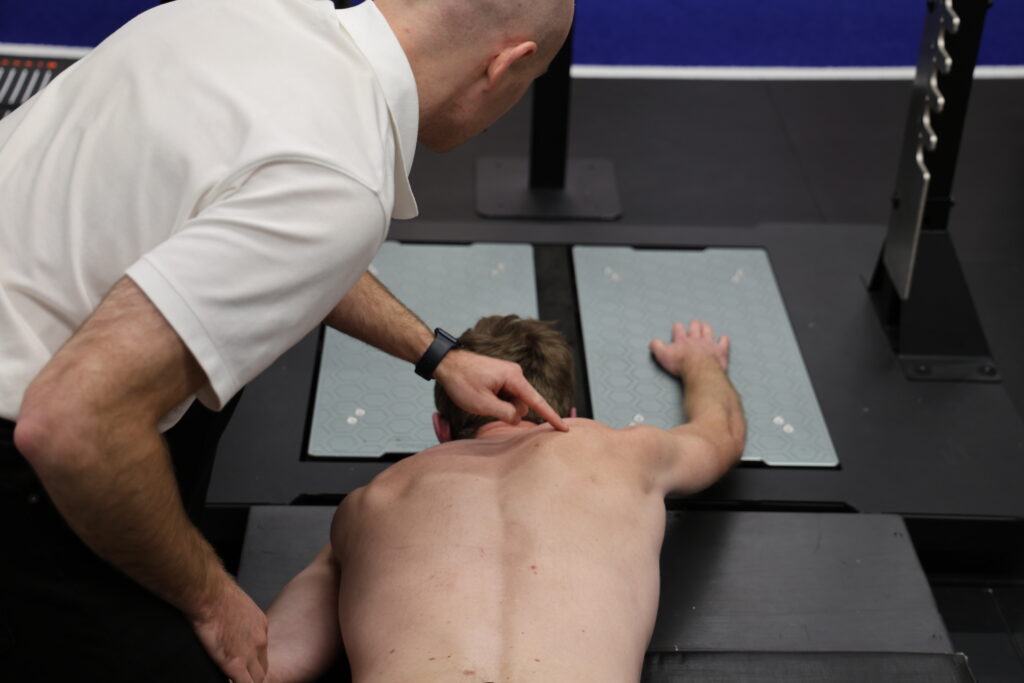
We use Vald Force Plate technology to measure both maximum strength and rate of force development (how quickly your muscles can generate force). This removes the guesswork. We can see exactly where the gap is and tailor your program to close it. Jake Smith works closely with patients recovering from shoulder dislocations and trauma to bridge this strength-to-power gap before they return to sport.
What to expect at your appointment
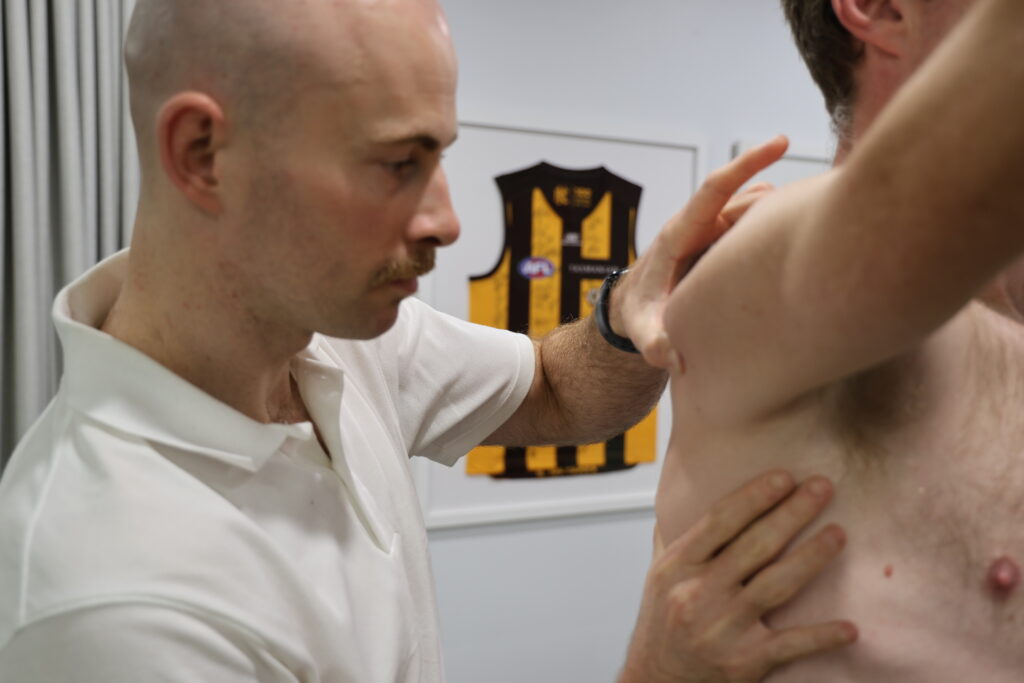
Your first session is about understanding where you are in your recovery and what you need to get back to. We will take a detailed history, assess your shoulder range, control, and strength, and look at how your shoulder works as part of the wider chain (scapula, trunk, and beyond).
If you are in the late stages of rehab, we will likely use objective testing including force plate data to measure both sides and identify any lingering deficits. From there, we build a plan that progresses you through the missing pieces, whether that is horizontal flexion control, rotational power, or sport-specific patterns.
If your shoulder rehab has plateaued, or you have been cleared to return but do not quite trust the shoulder yet, it is worth getting a proper review. Adrianna Cann and Jake Smith see these presentations regularly and can work out exactly what is missing — so you return to your sport performing, not just surviving.