

Shoulder pain that keeps coming back, never quite settles, or has been brushed off as a simple rotator cuff issue is one of the most common reasons people come to us for a second opinion. Often the real driver of the problem is something different — an unstable shoulder. Getting the diagnosis right is the first step to actually getting better.
What is shoulder instability?
Shoulder instability means the ball of the upper arm bone (the humeral head) does not stay properly centred in the shoulder socket (the glenoid). This can happen after a traumatic dislocation, or it can develop gradually without any clear injury. When the shoulder cannot hold itself in a stable position, surrounding structures like the rotator cuff (the group of muscles and tendons that control fine shoulder movement) often become overworked and painful.
Here is the tricky part. The rotator cuff might be sore, but that does not mean it is the actual cause. Sometimes it is the victim, not the culprit. An unstable shoulder forces the rotator cuff to work overtime trying to keep things in place, and over time that tissue becomes irritated. Treating the rotator cuff alone, without addressing the underlying instability, rarely fixes the problem long term.
Who is affected?
Shoulder instability turns up in two main groups. The first group includes people who have had a traumatic event — a dislocation from a fall, a tackle, or a sporting collision. After that initial injury, the shoulder can feel loose or unreliable. The second group is people with non-traumatic or multi-directional instability. These individuals often have naturally mobile joints and may notice their shoulder slipping or feeling unstable during everyday activities like reaching overhead, sleeping on their side, or carrying groceries.
Younger athletes, swimmers, throwers, and those involved in overhead sports are particularly prone to it. Many people with non-traumatic instability also describe a long history of vague shoulder discomfort that nobody has been able to pin down.
Signs and symptoms to look out for
- A sense that the shoulder is loose, slipping, or about to “pop out”
- Recurring pain that does not respond to standard rotator cuff exercises
- Clicking, clunking, or catching during shoulder movement
- Weakness or fatigue when lifting or reaching overhead
- Visible changes in how the shoulder blade sits on the rib cage (often called scapular winging)
- Discomfort when lying on the affected side at night
How is shoulder instability diagnosed?
Diagnosis is rarely a single test. Most orthopaedic tests for the shoulder are not accurate enough on their own to confirm or rule out a specific injury. Many of these tests stress several structures at once, which makes interpreting them in isolation unreliable. Used together as a cluster, however, they point us in the right direction.
Before we even focus on the shoulder, we need to make sure the neck is not the real source of pain. The cervical spine (the part of the spine in your neck) can refer pain into the shoulder and mimic shoulder problems. We assess neck range of motion and test whether moving the neck reproduces your symptoms. Ruling the neck in or out early saves a lot of time.
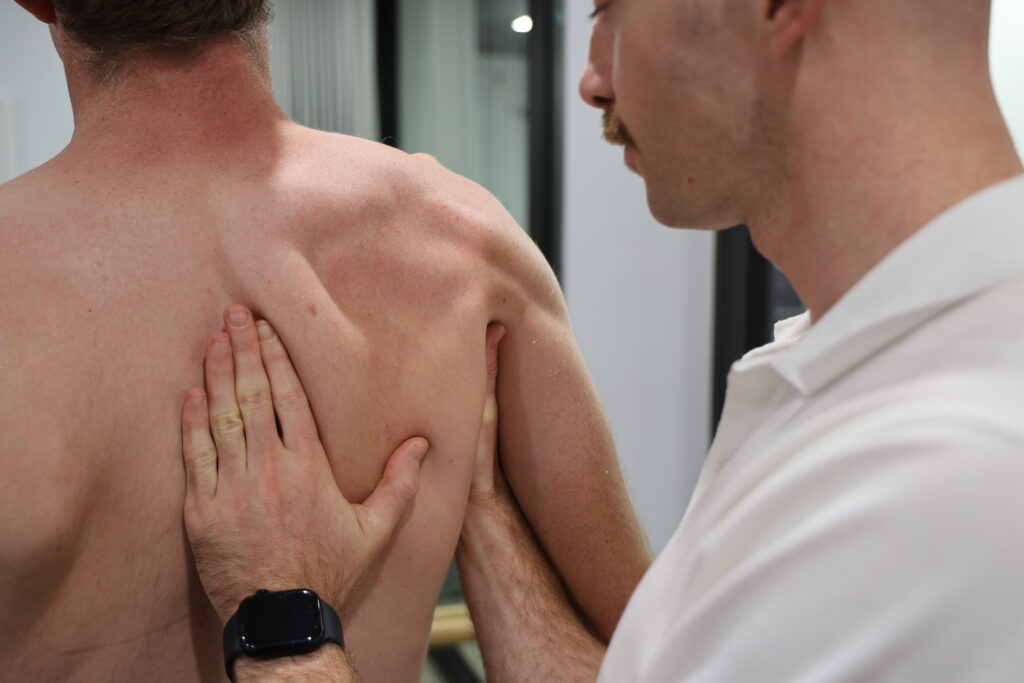
From there, we look closely at how your shoulder blade sits on your rib cage at rest and during movement. Scapular winging — where the shoulder blade does not sit flush — is common in people with multi-directional or posterior instability. Researchers think this is the body’s way of trying to recentre the humeral head in the socket. Altered muscle patterning and poor scapular control are hallmarks of non-traumatic instability.
What does treatment look like?
The goal of rehab is to restore stability, control, and strength so the shoulder can do its job without flaring up. Treatment is built around what we find during your assessment — there is no cookie-cutter plan that works for everyone with shoulder pain.
Physiotherapy
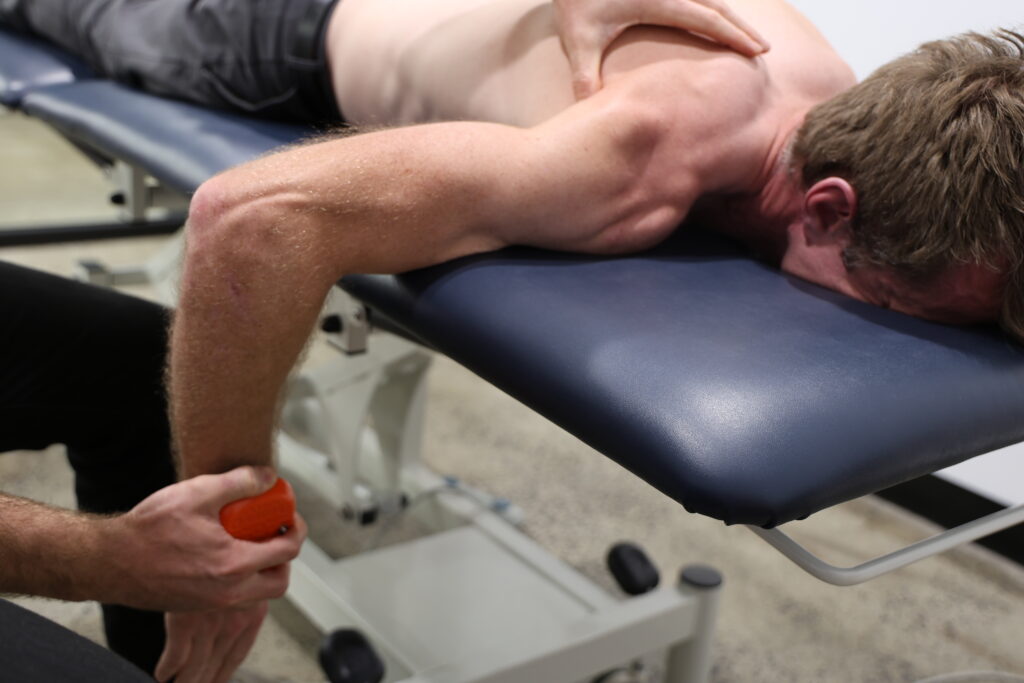
We start by checking two key things during the assessment. The first is your scapular (shoulder blade) position. The second is the position of the humeral head in the socket. By gently adjusting either of these and retesting your movement, pain, and strength, we can work out which positions your shoulder needs to be rehabilitated in. This guides the entire programme.
Our clinic uses a Vald handheld dynamometer, which is a device that measures how much force your shoulder produces in different positions. This gives us real numbers — not guesses — about where you are strong and where you are weak. We can then compare those numbers to gold-standard reference values for your age and activity level, and set clear targets to work towards. Jake Smith regularly uses this approach with patients recovering from dislocations and shoulder trauma, building rehab plans that are properly individualised.
For more complex or multi-directional presentations, Adrianna Cann, APA Titled Sports and Exercise Physiotherapist, leads our shoulder instability work and is particularly experienced in cases that have not responded to previous treatment.
Sports Medicine
If imaging is needed, or if surgical opinion becomes part of the conversation, we work alongside our sports doctors to coordinate that. Most cases of non-traumatic shoulder instability respond well to a well-structured rehab programme, and surgery is usually only considered when conservative care has not done the job.
What to expect at your appointment
Your first session is mostly conversation and assessment. We will ask detailed questions about how your shoulder behaves, when it bothers you, and what you want to get back to doing. Then we examine your neck, shoulder blade position, range of motion, and strength. Using the dynamometer, we capture objective strength numbers across different ranges. By the end of the session, you should have a clear understanding of what is driving your pain and what the rehab plan looks like.
If your shoulder has been niggling for months, keeps slipping out, or has not responded to generic rotator cuff exercises, instability is worth ruling in or out properly. Jake Smith and our shoulder team see these presentations regularly and can help you work out what is actually going on.
This article was written by Jake Smith, Physiotherapist at Melbourne CBD Physiotherapy and Sports Medicine Clinic.