

You have been doing your external rotation exercises with a resistance band for weeks. Your shoulder still feels loose, painful, or like it might slip out at any moment. If that sounds familiar, you are not alone — and the issue may not be how hard you are working, but the order in which you are working.
Shoulder instability rehab needs a very different approach to traditional shoulder strengthening. At our clinic, this is one of the most common presentations we see — patients who have been given the right exercises, but in the wrong sequence. Here is how we actually approach it.
What is shoulder instability?
Shoulder instability means the ball of the shoulder joint (the humeral head) does not stay properly centred within its socket (the glenoid). Sometimes this shows up as a frank dislocation. More often, it shows up as a vague feeling of looseness, clunking, pain with overhead movement, or a sense that the shoulder is about to give way.
There are a few different patterns. Anterior instability (where the shoulder tends to slip forward) is the most common. Posterior instability (where it tends to slip backward) and multi-directional instability (where it slips in more than one direction) are less common but very important to recognise, because they need a specific rehab approach.
Who is affected?
Shoulder instability tends to affect two groups. The first is younger people who have had a traumatic dislocation — often from contact sport, a fall, or a tackle. The second is people whose shoulders are naturally more mobile, including swimmers, throwers, gymnasts, dancers, and those with generally hypermobile joints. Many in this second group have never had a dislocation at all. They just notice the shoulder feels unreliable, especially with overhead or rotation movements.
If your shoulder hurts every time you do external rotation work and the pain is not settling, it is worth asking whether instability is the underlying driver rather than simple weakness.
Signs and symptoms to look out for
- A feeling of looseness, slipping or the shoulder “not feeling right”
- Pain with external rotation, overhead reaching or lying on the affected side
- Clicking, clunking or a sense of the shoulder shifting in the socket
- Apprehension or guarding when the arm is moved into certain positions
- Pain that persists or worsens despite doing rotator cuff strengthening
- A history of dislocation or subluxation (partial dislocation)
How is shoulder instability rehab managed?
This is where shoulder instability rehab differs most from generic shoulder programs. Rather than launching straight into rotator cuff strengthening, we work from the shoulder blade outwards.
Stage 1: Scapula control
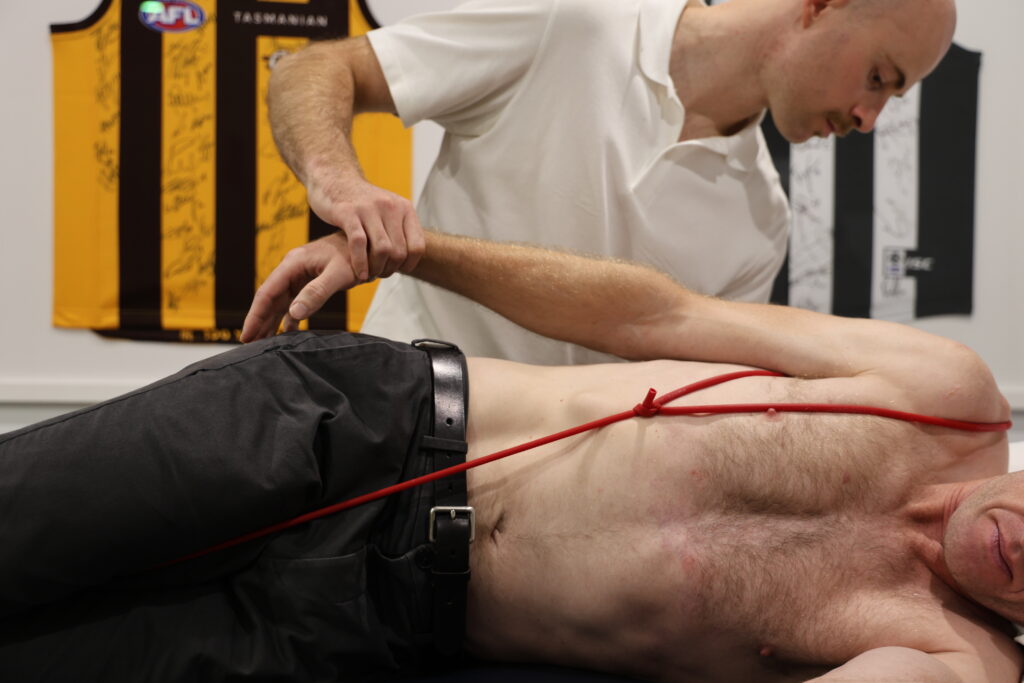
The scapula (shoulder blade) acts as the foundation for the entire shoulder joint. If the scapula sits in a poor position, the humeral head cannot stay centred — and no amount of rotator cuff work will fix that. So we start by retraining the shoulder blade to achieve upward rotation, and in some cases posterior tilting (where the bottom of the blade tips backward).
Small position changes can dramatically improve symptoms. Early exercises focus on motor control and movement quality rather than strength. A single arm shrug — either standing with a light weight, or side-lying if standing is too painful — is often where we begin. These are usually performed with a slightly lifted body position, which activates the scapula stabilisers more effectively than just letting the arm hang at the side.
Frequency matters more than load at this stage. Repeating these patterns often helps reinforce the connection from the brain to the surrounding shoulder muscles.
Stage 2: Adding controlled movement
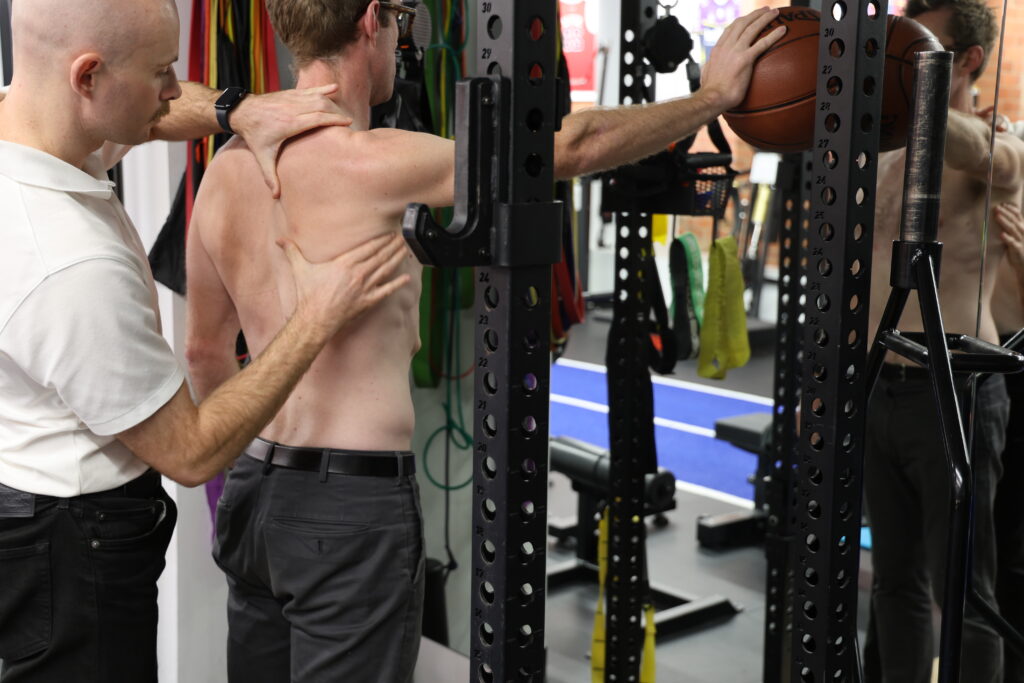
Once scapula control improves, we introduce small arcs of arm movement — usually 20 to 45 degrees — while the patient maintains a stable shoulder blade position. External rotation exercises are typically introduced first, as these help improve rotator cuff function and overall stability. Resistance bands placed around the scapula can be added to increase activation of the surrounding muscles.
Internal rotation is deliberately delayed in patients with multi-directional or posterior instability. Bringing it in too early encourages the chest muscles to dominate, which pulls the scapula into a poor position and often triggers pain.
Stage 3: Building the posterior shoulder
Once control is established and pain has settled, the focus shifts to building the muscles at the back of the shoulder. This is especially important for posterior instability, where the humeral head tends to drift backward in the socket. Forward flexion, internal rotation and horizontal adduction exercises help create a strong muscular buttress behind the joint. Bent-over row and incline row variations are introduced with careful attention to scapula position.
Our shoulder team, including APA Titled Sports and Exercise Physiotherapist Adrianna Cann, has particular experience guiding patients through this staged process — especially those with complex shoulder presentations and multi-directional instability.
What to expect at your appointment
Your first session involves a detailed history — when symptoms started, whether there has been a dislocation, what aggravates the shoulder, and what you have already tried. We then assess scapula position and control, range of motion, rotator cuff function, and apprehension testing to clarify the direction of instability. From there, we map out where you sit in the rehab sequence and start you on exercises that match your stage — not a generic program. Expect to be given a small number of exercises done frequently, rather than a long list done occasionally.
If your shoulder feels unstable and the usual exercises are not helping, the problem is often the sequencing rather than the effort. Adrianna Cann and Jake Smith see these presentations regularly and can help you work out which stage of rehab you actually need to be in.