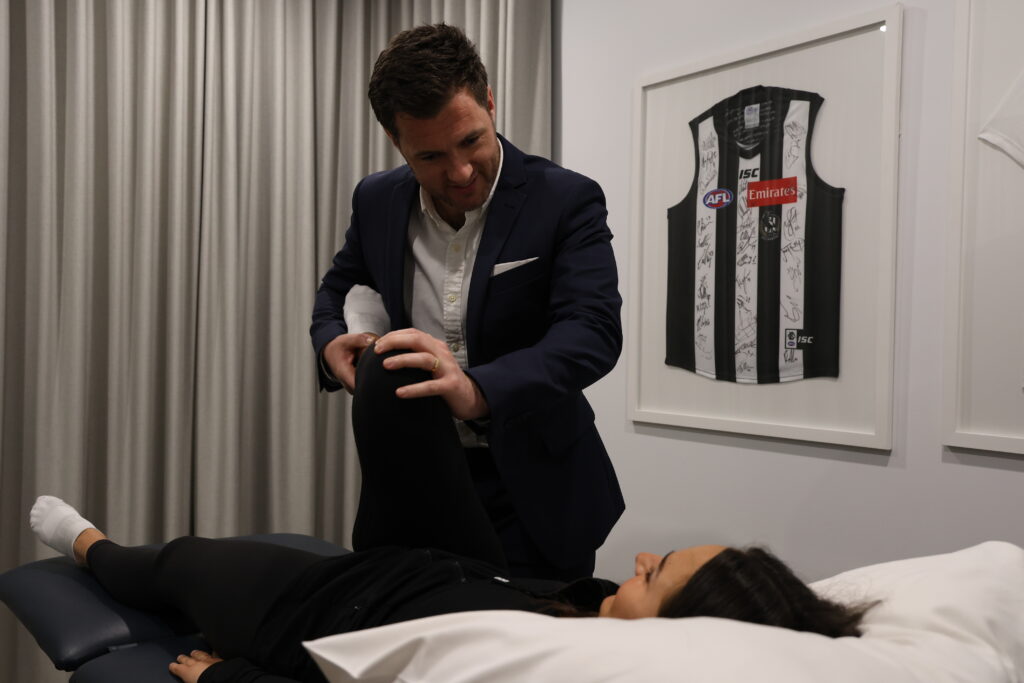
The shoulder and knee are the two most commonly injured joints in sport and active life. Both are complex, with multiple tissues — bone, cartilage, ligament, tendon, meniscus or labrum — that can be involved in any single presentation. That complexity is precisely why an accurate, specialist-led diagnosis matters so much.
Conditions we commonly manage include rotator cuff injuries, shoulder instability and dislocation, AC joint injuries, labral tears, meniscal tears, patellofemoral pain, ACL injuries and other knee ligament injuries, and early-stage osteoarthritis.
Frequently Asked Questions
Highly variable. Minor injuries: 1–4 weeks. Significant structural injuries: 3–12 months. Return to sport should be based on objective criteria — strength, stability, confidence and sport-specific testing — rather than calendar alone.

Frequently Asked Questions
Dr. Liam West will take a history covering mechanism of injury, pattern of symptoms and functional limitations, and perform a detailed joint-specific examination. X-ray may be used to identify fracture or arthritic change. MRI is the most informative investigation for soft-tissue problems such as rotator cuff tears, labral injuries and meniscal tears.
If you have a shoulder or knee problem limiting your sport or daily life, book an appointment with Dr. Liam West, our Specialist Sports and Exercise Physician at Melbourne CBD Physiotherapy and Sports Medicine Clinic. You can also learn more about our complete Sports Medicine service.
Book Now | Learn more about Sports Medicine
Dr Liam West is a Specialist Sport and Exercise Medicine (SEM) Physician and Head Doctor of Hawthorn Football Club. He brings extensive experience across AFL, Athletics (Track and Field) and Football (Soccer), with specialist expertise in bone, muscle, tendon and joint injuries. Liam served as Sports Doctor for the Australian Athletics Team at the 2018 & 2022 Commonwealth Games, and holds a Masters of Sports and Exercise Medicine and Fellowship of the Australasian College of Sport and Exercise Physicians.
Book with Dr. Liam West | Read Liam’s Full Biography
Ligament Injuries | Osteoarthritis | Injections | Muscle Injuries

Our team look forward to working with you to help achieve your goals
Risk of re-dislocation depends on your age, activity, the mechanism of injury and what was damaged internally. Younger, more active patients are at highest risk, which is why specialist assessment and imaging early on is valuable.
Mechanical symptoms like locking or catching can suggest a meniscal tear, loose body or cartilage injury, and should be assessed. Clicking alone without pain is usually nothing to worry about.
Risk of re-dislocation depends on your age, activity, the mechanism of injury and what was damaged internally. Younger, more active patients are at highest risk, which is why specialist assessment and imaging early on is valuable.
Highly variable. Minor injuries: 1–4 weeks. Significant structural injuries: 3–12 months. Return to sport should be based on objective criteria — strength, stability, confidence and sport-specific testing.