

Runner’s knee is a broad term encompassing several common overuse knee conditions seen in runners and cyclists, including iliotibial band syndrome (ITBS) and patellofemoral pain syndrome. It is characterised by pain around or on the outside of the knee that develops during or after activity.
Our knee clinic is led by Dr. Tim Sayer, whose PhD research focused specifically on knee conditions affecting active people — including patellofemoral pain syndrome, one of the most common causes of runner’s knee. This evidence-based expertise is directly relevant to your recovery.
Frequently Asked Questions
Runner’s knee most commonly refers to one of two conditions:
Iliotibial Band Syndrome (ITBS): Pain on the outer side of the knee where the IT band rubs over the lateral femoral condyle during repetitive knee flexion. It is one of the most common overuse injuries in distance runners.
Patellofemoral Pain Syndrome (PFPS): Pain around or behind the kneecap, worsened by downhill running, squatting, and stairs. Dr. Tim Sayer‘s PhD focused specifically on this condition.
Both conditions are driven by:

Frequently Asked Questions
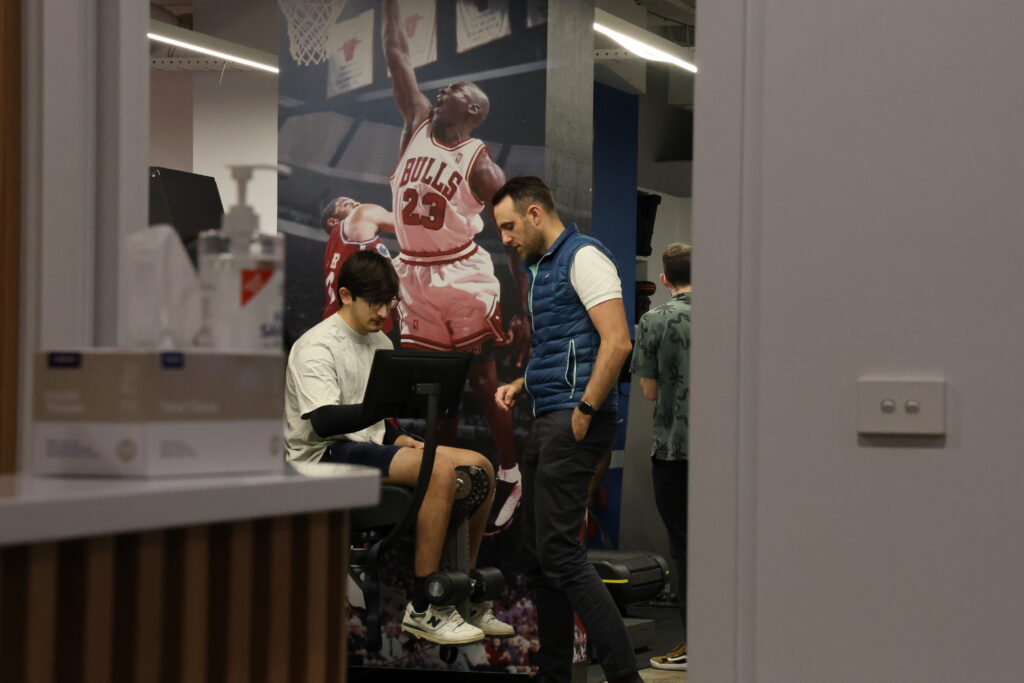
At Melbourne CBD Physiotherapy & Sports Medicine, we use objective Kineo isokinetic strength testing to identify hip and quadriceps strength deficits driving your pain. This data guides a precision rehabilitation program and gives you clear targets for return to running.
Treatment for runner’s knee typically includes:
Dr. Tim Sayer is Co-Director of Melbourne CBD Physiotherapy & Sports Medicine. He holds a Doctor of Physiotherapy (DPT) and a PhD focused on ACL injury and patellofemoral pain syndrome — one of the key causes of runner’s knee. He is an Honorary Senior Research Fellow at the University of Melbourne and a member of Team ACL.
Tim has worked as sports physiotherapist with Melbourne Storm and regularly treats runners and athletes returning from knee injuries. His research means your care is guided by the strongest available evidence.

Our team look forward to working with you to help achieve your goals
Hip strengthening — particularly gluteus medius exercises — is consistently the most evidence-supported intervention. Your physiotherapist will prescribe a specific program based on your individual weakness profile from isokinetic testing.
With appropriate management, most cases improve within 4–8 weeks. Returning to full training may take 8–12 weeks depending on severity and rehabilitation compliance.
Hip strengthening — particularly gluteus medius exercises — is consistently the most evidence-supported intervention. Your physiotherapist will prescribe a specific program based on your individual weakness profile from isokinetic testing.
Runner’s knee is typically an overuse injury, not a structural problem. With the right management it resolves well and rarely leads to long-term joint damage. However, if left untreated it can become chronic and significantly disrupt training.















Our Knee Clinic Melbourne CBD provides specialist physiotherapy for runner’s knee (iliotibial band syndrome and patellofemoral pain) and a full range of knee conditions affecting runners and cyclists. Led by Tim Sayer, Director and Senior Physiotherapist, the clinic combines biomechanical assessment and gait analysis with evidence-based rehabilitation.